TRADEMARK
What is a trademark or service mark?
A trademark is generally a word, phrase, symbol, or design, or a combination thereof, that identifies and distinguishes the source of the goods of one party from those of others. • A service mark is the same as a trademark, except that it identifies and distinguishes the source of a service rather than goods. Throughout this booklet, the terms “trademark” and “mark” refer to both trademarks and service marks. Do trademarks, copyrights, and patents protect the same things? No. Trademarks, copyrights, and patents protect different types of intellectual property. A trademark typically protects brand names and logos used on goods and services. A copyright protects an original artistic or literary work. A patent protects an invention. For example, if you invent a new kind of vacuum cleaner, you would apply for a patent to protect the invention itself. You would apply to register a trademark to protect the brand name of the vacuum cleaner. And you might register a copyright for the TV commercial that you use to market the product.
TRADEMARK RESEARCH:
Why should I get trademark search? Conducting a complete search of your mark before filing an application is very important because the results may identify potential problems, such as a likelihood of confusion with a prior registered mark or a mark in a pending application. A search could save you the expense of applying for a mark in which you will likely not receive a registration because another party may already have stronger rights in that mark. Also, the search results may show whether your mark or a part of your mark appears as generic or descriptive wording in other registrations, and thus is weak and/or difficult to protect.
Similarity of Marks
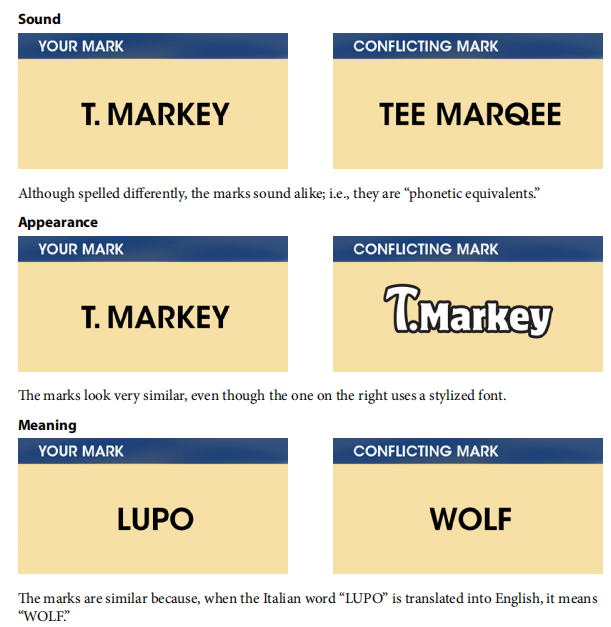
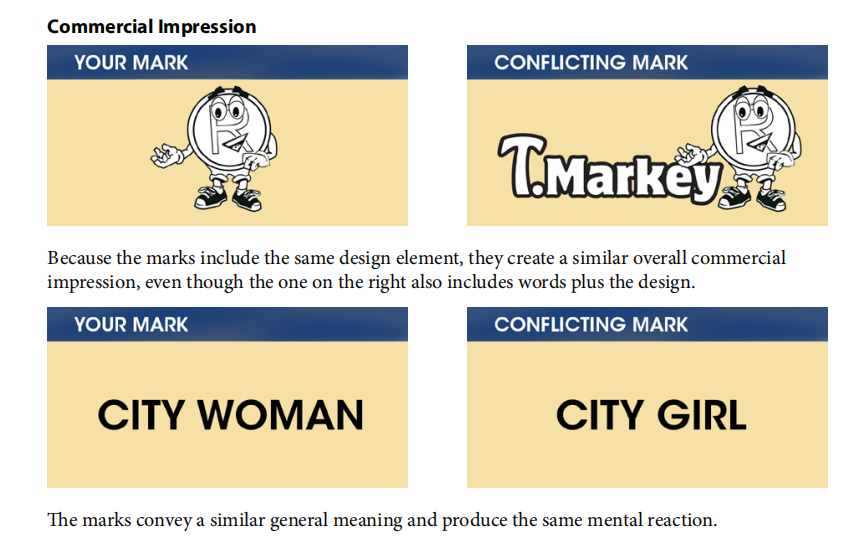
To determine whether a likelihood of confusion exists, the marks are first examined for their similarities and differences. Note that in order to find a likelihood of confusion, the marks do not have to be identical. When marks sound alike when spoken, are visually similar, have the same meaning (even if in translation), and/or create the same general commercial impression in the consuming public’s mind, the marks may be considered confusingly similar. Similarity in sound, appearance, and/or meaning may be sufficient to support a finding of likelihood of confusion, depending on the relatedness of the goods and/or services.
Relatedness of Goods and/or Services
Even if two marks are found to be confusingly similar, a likelihood of confusion will exist only if the goods and/or services upon which or in connection with the marks are used are, in fact, related. Whether the goods and/or services are related is determined by considering the commercial relationship between the goods and/or services identified in the application with those identified in the registration or earlier-filed application. To find relatedness between goods and/or services, the goods and/or services do not have to be identical. It is sufficient that they are related in such a manner that consumers are likely to assume (mistakenly) that they come from a common source. The issue is not whether the actual goods and/or services are likely to be confused but, rather, whether a likelihood of confusion would exist as to the source of the goods and/or services.
This is just a general search to see if there is a mark that may conflict with your mark. Disclaimer there is no way to guarantee that your mark will be available even after a general search is completed because things change in the database on a daily basis as soon as someone files.
